
Hawks, Falcons Becoming a Sought-After Solution for Clearing the Air
A property management company in Long Beach became sick and tired of crows flocking together over its commercial buildings, gathering together to squawk loud messages to their comrades. They were joined by pigeons and sparrows, who would be pelting office windows and cars with droppings.
The commonly used tactics to scare off these birds weren’t taking care of the problem. Barbed wire spikes on rooftops just got these birds to land a little bit farther away. Electric shock traps had the same results.
Then came the falconer who understood that raptors – predatory birds such as hawks and falcons – could solve the problem.
Ignacio Flores, founder of Urban Falconry, has solved this problem for this property owner with the assistance of raptors from the family of Harris Hawks. These hawks are known for hunting in packs of three birds, which is how Flores sometimes has them fly together searching for prey.
Flores says that while falconry has been growing in popularity in recent years, there’s still a long way to go. There are reports of crows flying together in flocks of 600 to 700 birds across Los Angeles County and other parts of the state. The same is true of ravens, the smaller blackbirds, he said.
Urban Falconry has been providing its services to communities across the Southland for the past 12 years. He says there are about 6,500 falconers working the U.S., with many of them in Southern California.
How He Got Into the Craft
Born in Mexico City and the son of a doctor, becoming a falconer didn’t appear to be anything beyond a hobby to him for several years. After his parents divorced, his time was split going back to Mexico City with his father, and then to the Baja area in Tijuana, and sometimes in San Diego, while living with his mother.
He clearly remembers reading an article and seeing photos from National Geographic, and then watching a BBC TV program about being a falconer. During high school, he got to meet one of them, a female classmate who trained him in the discipline. She taught him that a deep bond must be set by the falconer with the hawks and falcons.
“They haven’t been domesticated,” he said. “They’re afraid of humans. You have to open channels with raptors over time.”
His love of falconry was put on the back burner after finishing college and going into the banking industry. His main objective became looking for effective methods for Mexican customers who worked in the U.S. to be able to easily and safely transfer funds back to family in Mexico.
A job that started out at a bank in Baja ended up transferring him to their location in Los Angeles. He began the process of becoming a U.S. citizen while also staying up on falconry.
He learned that falconers have an important role to play – providing the services of these skilled hunters while also seeing the impact of what’s going on in the atmosphere and environment. He found out they’d played an important part in alerting the federal government, through the U.S. Dept. of Agriculture, that the DDT insect repellent was having devastating effects on these raptors. It became part of how DDT was eventually banned by the federal government, he said.
These days, the biggest concern that bird lovers have is bird flu, which has taken the lives of millions of mallards, geese and ducks in the U.S. and beyond. Raptors that prey on water areas have also been susceptible to the flu, as well.
Environmental and Health Impact of Birds
One of the major concerns for property developers, government officials and environmental groups has been the impact that seagulls can have on the local ecosystem. They’ll be looking for water and food, which can take place at a refuse landfill and then be carried over to a pond or other waterway.
Cross-contamination becomes the problem. The seagull will pick up that contamination at a landfill and carry it to other birds and species.
That’s where falcons and hawks can provide a solution through getting the seagulls to leave these vulnerable areas.
Flores has gone through training in his profession to follow state and federal guidelines. In this state, falconry is regulated by the California Department of Fish and Wildlife. The U.S. Fish & Wildlife Service is the federal agency. His firm is fully licensed and in compliance with federal and state regulations that operate under the federal Migratory Bird Treaty Act (MBTA) through these state and federal agencies.
The state has restrictions on what raptors can be used in falconry. Domestic, protected birds like the Red-Tailed Hawk and American Kestrel Falcon will be allowed. What can be carried out by falconers under the state regulations are governed by three levels to be reached – apprentice for the first three years in the profession, general for five years, and then master. Bird owners who raise them can only sell to those at the general and master level, he said.
Flores says that the federal laws are more focused on abatement, which can take the form of clearing a landfill of seagulls and other birds who can be spreading contamination. Peregrine Falcons can be ideal for working at landfills, shopping centers and office buildings, he said.
Abatement is the term used for strategic use of trained raptors to deter, harass, or, in specific permitted cases, capture nuisance wildlife – primarily birds – that pose risks to agriculture, property, health, safety, or business operations.
Protecting vineyards from abatement can come through Aplomado Falcons, which are not native in this area, he says. Federal rules don’t have the same domestic breed requirements.
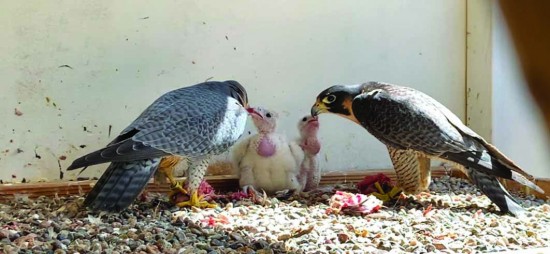
He’s been breeding Harris Hawks and Peregrine Anatum Falcons in recent years. There’s been a lot of demand for them in the urban environment. Once the newborn comes along, there’s good deal of time and training the falconer needs to put in.
Each of these types has their own role to play. Overall, he says that it’s more like comparing Toyotas to Ferraris. Hawks can fly up to 60 miles per hour, while falcons can make it to 200 mph.
Hawks have broad wings and prey on small animals and birds. Falcons fly very high and hunt for birds.
There are other birds in the raptor family including eagles, vultures and accipiters – which are similar to hawks. Hawks and eagles at some point became partners to falconers.
If all goes well, these birds can fly in service for 20 or more years, with many of them living until age 25.
So far, all of his birds have returned to him after flying their missions. He’s very grateful for that.
Jon LeSage is a resident of Long Beach and a veteran business media reporter and editor. You can reach him at jtlesage1@yahoo.com.
Category:
- Log in to post comments
Featured Video

Beachcomber
Copyright 2026 Beeler & Associates.
All rights reserved. Contents may not be reproduced or transmitted – by any means – without publisher's written permission.

